The Women’s Health Initiative hormone trials produced two findings that should remain separate: prior assignment to conjugated equine estrogen alone was associated with fewer breast cancers and breast cancer deaths among women with a previous hysterectomy, while conjugated equine estrogen plus medroxyprogesterone acetate was associated with more breast cancers among women with a uterus. These were two placebo-controlled randomized trials, not a direct contest between the hormone regimens.
That design matters when applying the results to today’s hormone discussions. Neither trial tested all estrogen products, all progesterone formulations, or all delivery routes. And more than 20 years of cumulative follow-up did not mean 20 years of assigned medication. This analysis uses the indexed primary report abstracts for WHI and ELITE, together with available official prescribing information and FDA material; it does not represent a review of their full protocols or supplements.
Study facts at a glance
Two randomized populations: WHI enrolled 10,739 women with prior hysterectomy in the estrogen-alone trial and 16,608 women with a uterus in the estrogen-plus-progestin trial. Source 1
Treatment was shorter than follow-up: Median intervention duration was 7.2 years for estrogen alone and 5.6 years for the combination; cumulative follow-up extended beyond 20 years. Source 1
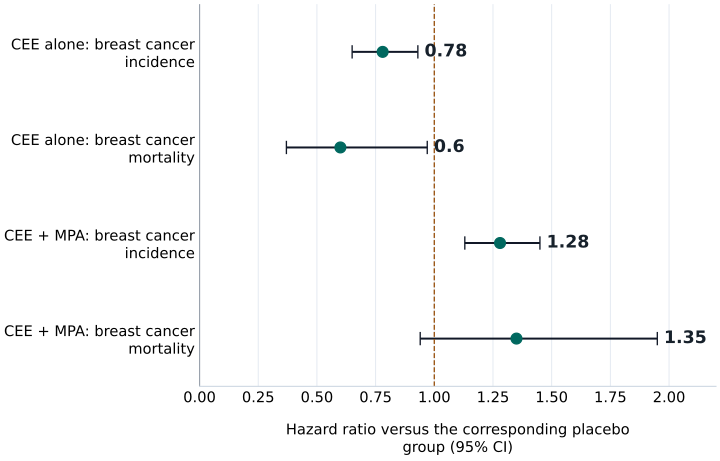
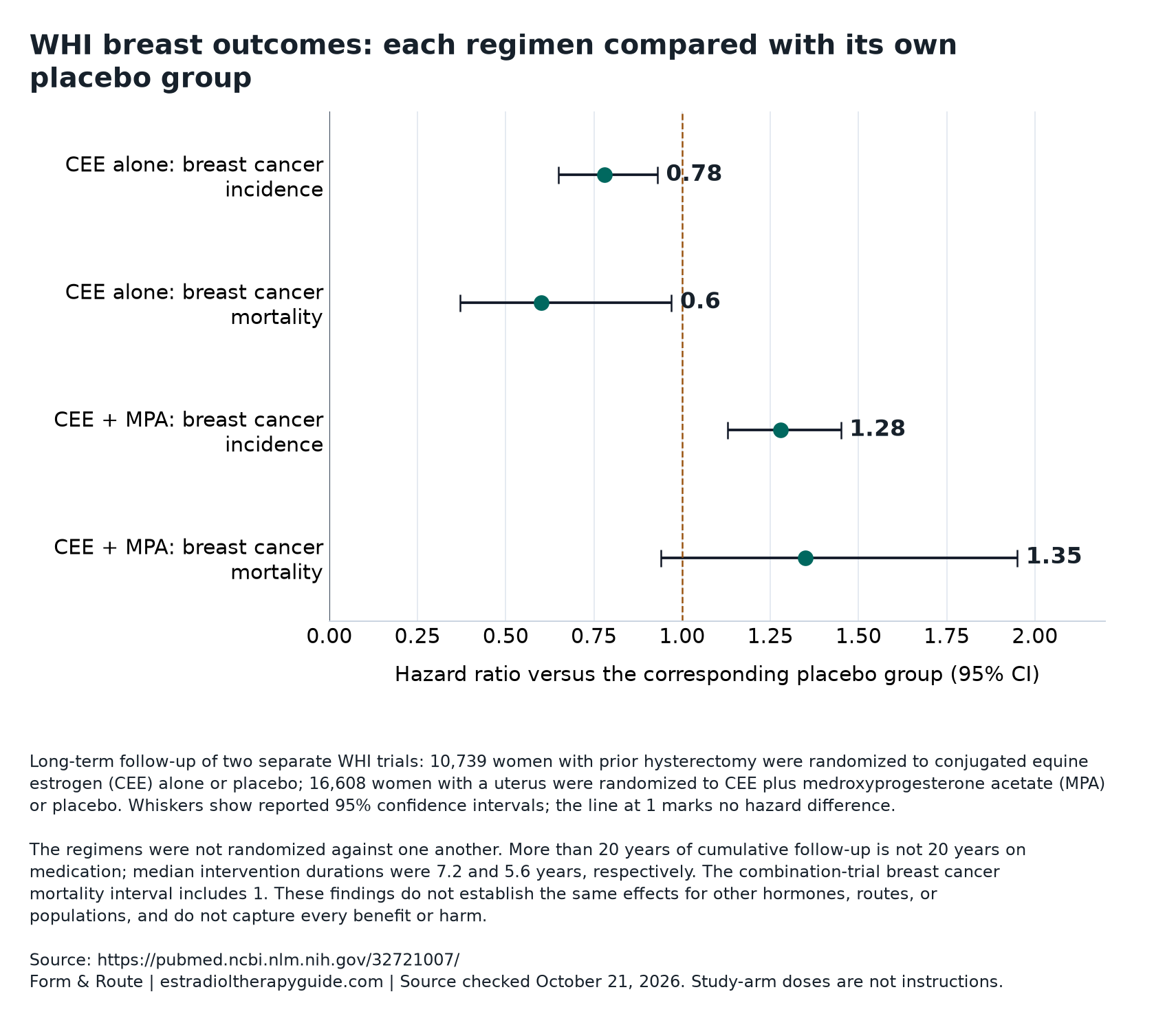
Estrogen-alone breast outcomes: Compared with placebo, CEE alone had a breast cancer incidence hazard ratio of 0.78 and a breast cancer mortality hazard ratio of 0.60. Source 1
Combination breast outcomes: CEE plus MPA increased breast cancer incidence, with a hazard ratio of 1.28. Its breast cancer mortality estimate was not statistically significant. Source 1
Label revisions are product-specific: FDA announced boxed-warning changes for an initial six menopausal hormone products in February 2026; remaining warnings and contraindications still require product-level review. Source 4 Source 2
The comparison started with uterine history
The trials enrolled 27,347 postmenopausal women at 40 US centers from 1993 through 1998. Participants were 50–79 years old, averaging 63.4 years at baseline, with a standard deviation of 7.2 years. They had no previous breast cancer and a negative screening mammogram at entry. Those eligibility conditions define the population behind the results; the study was not a trial of hormone treatment after breast cancer.
Among women with prior hysterectomy, 5,310 were randomized to conjugated equine estrogen, abbreviated CEE, and 5,429 to placebo. Among women with a uterus, 8,506 were randomized to CEE plus medroxyprogesterone acetate, or MPA, and 8,102 to placebo. Randomization supports comparisons inside each trial, where the assigned medicine was tested against its own control group.
It does not make the two hormone groups interchangeable. Uterine history separated the populations before treatment assignment. Comparing their results can identify an important pattern, but cannot isolate what adding MPA would have done in an otherwise identical population.
Source 1
Read the underlying chart data: download CSV or download the source-labeled chart.
What the estrogen-alone trial found
Among women with a previous hysterectomy, there were 238 breast cancers in the CEE group and 296 in the placebo group. Annualized incidence was 0.30% versus 0.37%. The hazard ratio was 0.78, with a 95% confidence interval of 0.65–0.93, a statistically significant association with lower incidence.
The mortality finding pointed in the same direction: 30 breast cancer deaths with CEE versus 46 with placebo. Annualized breast cancer mortality was 0.031% versus 0.046%; the hazard ratio was 0.60, with a 95% confidence interval of 0.37–0.97. This was also statistically significant, although based on substantially fewer events than the incidence analysis.
Those two endpoints should not be collapsed into one claim. Incidence measures new diagnoses; breast cancer mortality measures deaths attributed to breast cancer. Their agreement strengthens the descriptive pattern in this trial, but neither establishes that CEE should be prescribed to prevent breast cancer. The findings also do not establish the corresponding effect of oral estradiol, patches, gels, or compounded preparations.
Long-term breast outcomes: each active regimen versus its own placebo group
Source 1
The combination increased diagnoses, with mortality less certain
In the trial involving women with a uterus, CEE plus MPA was associated with 584 breast cancers versus 447 with placebo. Annualized incidence was 0.45% versus 0.36%. The hazard ratio of 1.28, with a 95% confidence interval of 1.13–1.45, supported a statistically significant increase in breast cancer incidence.
Breast cancer deaths numbered 71 versus 53, with annualized mortality rates of 0.045% and 0.035%. The mortality hazard ratio was 1.35, but its 95% confidence interval, 0.94–1.95, included 1. The report therefore did not find a statistically significant mortality difference.
That is not proof of no mortality effect. The interval remains compatible with effects ranging from a modestly lower hazard to a substantially higher one. There were fewer deaths than diagnoses, leaving mortality estimated less precisely. Conversely, the significant incidence finding should not be translated into a claim that breast cancer deaths definitively increased.
Source 1
Reading the numbers without turning rates into probabilities
A hazard ratio compares the rate at which an event occurs over time among participants still at risk. A value of 0.78 corresponds to an estimated 22% lower hazard, not a 22-percentage-point reduction in the chance of cancer. Likewise, 1.28 describes an estimated 28% higher hazard, not 28 additional cancers per 100 participants.
The annualized rates provide a different scale. For estrogen alone, 0.37% minus 0.30% is 0.07 percentage points per year, equivalent to about seven fewer diagnoses per 10,000 person-years. For the combination, 0.45% minus 0.36% is 0.09 percentage points, or about nine more diagnoses per 10,000 person-years. These are differences between rounded annualized rates, not individual forecasts.
Multiplying those differences by 20 would not yield a valid 20-year treatment effect. Treatment stopped earlier, hazards need not remain constant, and follow-up time contributes to the rate calculations. Similarly, dividing case counts by the original group sizes does not reproduce the time-to-event analysis. The abstract does not supply a basis for calculating a reliable number needed to treat or harm.
Source 1
What long follow-up strengthens—and leaves unresolved
Mortality information was available for more than 98% of participants. That supports confidence in the completeness of death follow-up, but says nothing equivalent about medication adherence. It also should not be read as a statement that every endpoint had the same level of ascertainment.
Breast cancer incidence was the primary endpoint of this long-term analysis and had been a protocol-prespecified primary monitoring outcome for harm. Breast cancer deaths and deaths after breast cancer were secondary endpoints. Death from breast cancer is not synonymous with death after a breast cancer diagnosis, because the latter can include other causes. The abstract reports the numerical results for breast cancer mortality, not a complete numerical account of every secondary endpoint.
The available abstract does not provide detailed adherence patterns, postintervention medication histories, or a full explanation of how effects evolved after treatment ended. Those gaps limit mechanistic interpretation. The long follow-up identifies a lasting pattern associated with prior assignment, but does not explain why that pattern differed between the two trials.
Source 1
ELITE answered an arterial imaging question, not the breast question
ELITE randomized 643 healthy postmenopausal women within groups defined by time since menopause: less than six years or at least ten years. Participants received oral 17β-estradiol at 1 mg daily or placebo; women with a uterus also received sequential vaginal progesterone gel or placebo gel. Its primary endpoint was change in carotid intima-media thickness, an ultrasound measurement of arterial wall thickness, assessed every six months.
After a median five years, early-postmenopause participants had progression of 0.0044 mm per year with estradiol versus 0.0078 with placebo. The difference was 0.0034 mm per year less thickening. In the later group, rates were 0.0100 versus 0.0088 mm per year. The treatment-by-timing interaction was statistically significant, but coronary CT measures did not differ significantly in either group.
That imaging finding does not establish fewer heart attacks, and it does not resolve breast cancer risk. The NIH National Institute on Aging funded ELITE; its indexed abstract does not provide a detailed adverse-event account. Our ELITE trial analysis examines the timing result without converting a vascular measurement into a clinical prevention claim.
Three evidence settings that should not be treated as interchangeable
Source 3 Source 1 Source 2
A modern oral capsule is still a different formulation
BIJUVA contains oral estradiol and progesterone, not CEE and MPA. Its indication is moderate to severe menopausal vasomotor symptoms in women with a uterus. The label describes a randomized 12-week symptom substudy within a 52-week safety study; symptom reduction over weeks is a different evidentiary task from measuring cancer outcomes over decades.
In the label’s adverse-reaction table, breast tenderness occurred in 4.0% with the 0.5 mg estradiol/100 mg progesterone arm and 10.4% with the 1 mg/100 mg arm, versus 0.7% with placebo. Headache occurred in 4.0%, 3.4%, and 0.7%, respectively. These figures come from groups of 424, 415, and 151 women, not from the WHI populations.
The label states that the extent of WHI breast and cardiovascular risks for other products, doses, and routes is not known. Lack of direct equivalence is not evidence of zero risk. A label and pharmacy-record check helps identify the actual formulation, while a complete medication-list review addresses a separate issue: interactions and concurrent exposures.
Source 2
Breast outcomes do not summarize the whole safety profile
The official label’s account of the WHI combination treatment period reports increased stroke, deep vein thrombosis, and pulmonary embolism compared with placebo. For example, stroke rates were 33 versus 24 per 10,000 women-years, with an estimated ratio of 1.37 and a 95% confidence interval of 1.07–1.76. Pulmonary embolism rates were 18 versus nine, with a ratio of 1.98 and interval of 1.36–2.87.
Those are treatment-period findings for CEE plus MPA, not the same observation window as the long-term breast analysis. The label notes that these ratios were estimated using hazard models. They should not be blended with decades-long cancer follow-up as though all numbers describe one exposure period or one outcome.
Current BIJUVA contraindications include breast cancer or its history, unexplained genital bleeding, certain clotting disorders, liver disease, and active or previous venous or arterial thromboembolic disease. Remaining warnings cover cardiovascular disorders and malignancies. A favorable result on one breast endpoint cannot establish overall safety, and an arterial imaging improvement cannot cancel a cancer or clotting concern.
Source 2 Source 1
Updated warnings do not erase formulation-specific evidence
On February 12, 2026, FDA announced approved labeling changes for an initial six menopausal hormone products, removing cardiovascular disease, breast cancer, and probable dementia risk statements from their boxed warnings. The announcement followed a broader request for changes, but did not establish that every marketed product’s label had completed revision.
The current BIJUVA information records removal of its boxed warning while retaining contraindications and cardiovascular and malignancy warnings. A change in warning placement is a regulatory action, not a new randomized comparison proving that every hormone formulation has the same benefits or that previously observed risks disappeared.
Editorial interpretation: when evaluating care arrangements, the useful documentary question is which medicine, route, and follow-up responsibilities are actually specified—not whether a service invokes WHI or newer labeling in general terms. The Alloy review and Midi review can be used to check documentary terms. Neither link implies that a provider offers a studied regimen or reproduces trial outcomes; clinical evidence does not transfer automatically to providers or compounded products.
Source 4 Source 2 Source 1
Questions about the evidence
Did WHI directly show that adding MPA caused the opposite breast cancer result?
No. Each trial randomized its own participants against placebo. Women with hysterectomy entered the CEE-alone trial; women with a uterus entered the combination trial. The contrast between results is important, but it is not a randomized test of adding MPA to CEE in the same population.
Source 1
Does lower breast cancer mortality with CEE alone mean estrogen prevents cancer?
It supports a narrower conclusion: prior randomized CEE use was associated with lower breast cancer mortality in this hysterectomy population. There were 30 versus 46 deaths, and the confidence interval was fairly wide. The finding does not establish prevention prescribing or an equivalent benefit for estradiol, patches, gels, or other formulations.
Source 1
Why can incidence increase significantly while mortality does not?
The endpoints involve different events and different event counts. In the combination trial, there were 1,031 diagnoses across groups but 124 breast cancer deaths. Fewer events generally leave greater uncertainty. The mortality interval included no difference, but also allowed a substantial increase; statistical nonsignificance does not settle the question.
Source 1
Does ELITE show that starting closer to menopause removes breast cancer risk?
No. ELITE tested whether oral estradiol affected arterial imaging differently according to time since menopause. It found a timing-related difference in carotid wall-thickness progression, not proof of lower breast cancer risk. Nor did that surrogate endpoint establish fewer heart attacks or strokes.
Source 3
What should readers make of the 2026 boxed-warning changes?
They should distinguish a revised warning format from the complete prescribing information. FDA’s initial announcement concerned six products, not proof that every label had changed. BIJUVA’s current information retains contraindications and substantive warnings. Exact product identity remains necessary before interpreting what a regulatory update means.
Source 4 Source 2