The ELITE trial tested a specific version of the menopause timing hypothesis: whether oral estradiol affects arterial changes differently when started relatively soon after menopause rather than much later. Among 643 healthy postmenopausal women, estradiol slowed thickening of the carotid artery wall in the earlier-menopause group but not the later group. That result supports a timing-dependent effect on one measure of subclinical atherosclerosis—arterial change without necessarily causing symptoms or clinical events—not proof that treatment prevents heart attacks.
The formulation matters as much as the timing. ELITE studied oral 17β-estradiol, with sequential vaginal progesterone for participants with a uterus. It was not a patch trial or a trial of a combined oral estradiol-progesterone capsule. This analysis uses the indexed primary report abstracts for ELITE and the long-term Women’s Health Initiative breast cancer follow-up, alongside official prescribing information and FDA material. Together, they answer different questions about imaging, cancer outcomes, and current product labeling.
Study facts at a glance
Population and allocation: ELITE randomized 643 healthy postmenopausal women to estradiol or placebo within groups defined as less than 6 years or at least 10 years since menopause. Source 1
Studied regimen: The active arm used oral estradiol 1 mg daily, plus sequential vaginal progesterone gel for women with a uterus; these doses identify the research arms, not treatment instructions. Source 1
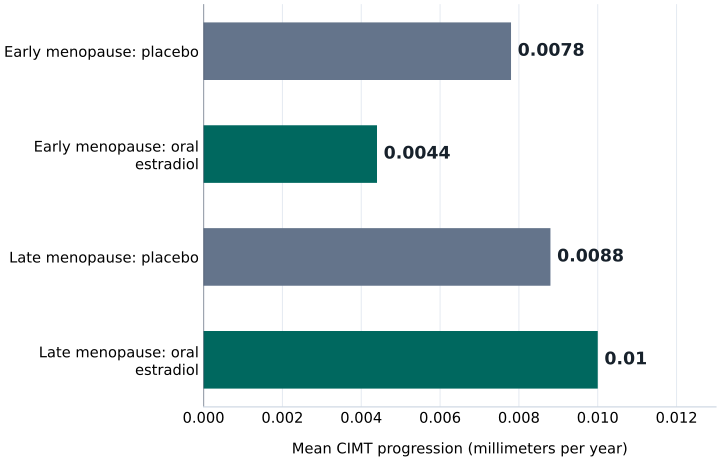
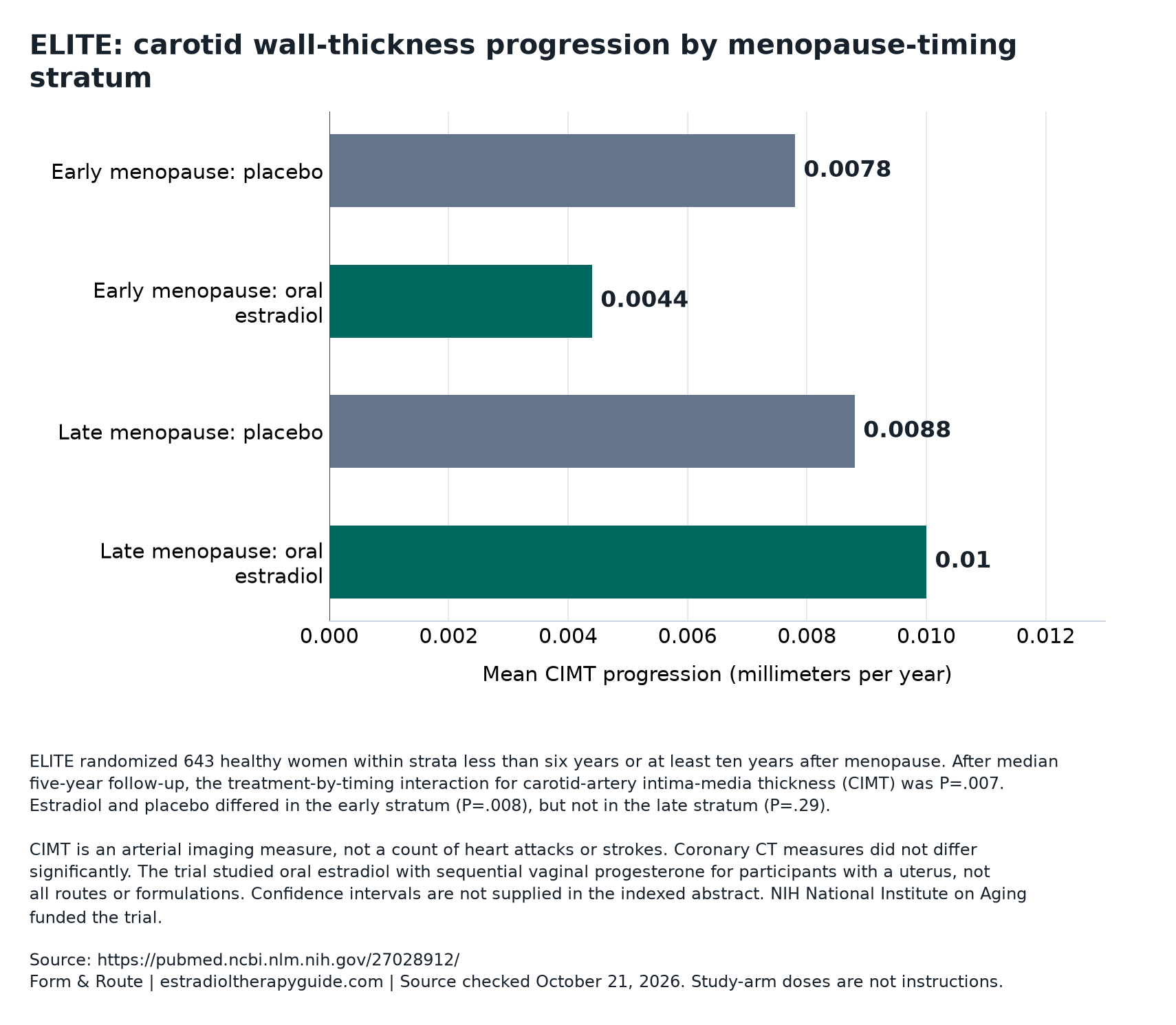
Earlier-menopause result: Carotid wall thickness increased by 0.0078 mm/year with placebo and 0.0044 mm/year with estradiol, an absolute rate difference of 0.0034 mm/year. Source 1
Timing interaction: The treatment effect differed between timing groups, with an interaction P value of 0.007; coronary CT measurements showed no significant treatment differences in either group. Source 1
Current labeling context: FDA announced boxed-warning changes for an initial six menopause hormone products in February 2026, but product-specific contraindications and other warnings remain important. Source 4 Source 3
Randomization tested treatment within two menopause-timing groups
ELITE first separated participants by time since menopause: fewer than 6 years, described as early postmenopause, or at least 10 years, described as late postmenopause. Within those strata, women were randomly assigned to estradiol or placebo. This design created treatment comparisons within each timing category rather than simply comparing hormone users with nonusers.
Participants were not randomly assigned to experience menopause earlier or later, or to wait a specified number of years before entering the study. Consequently, randomization supports the estradiol-versus-placebo comparisons within the groups, while the biological explanation for why those comparisons differed remains a separate question. Time since menopause may capture more than one underlying difference.
The trial’s healthy population also matters. Its findings do not directly establish outcomes in women with established cardiovascular disease. Nor does the design fill in the interval between 6 and less than 10 years since menopause. The National Institute on Aging, part of the National Institutes of Health, funded the trial.
Source 1
Read the underlying chart data: download CSV or download the source-labeled chart.
The intervention combined a specific estrogen route with a conditional progesterone regimen
The estrogen intervention was oral 17β-estradiol at 1 mg per day. Women with a uterus also received 45 mg vaginal progesterone gel daily for 10 days of each 30-day cycle. The comparator was placebo, with sequential placebo vaginal gel for women with a uterus. These details define the experimental treatment rather than a general category called hormone therapy.
The vaginal component was progesterone, not vaginal estrogen. Confusing those medicines would change both the hormone identity and the interpretation of the regimen. The guide to vaginal estrogen product identity addresses that naming problem, while questions about patches, tablets, and gels help keep route separate from ingredient.
ELITE did not compare oral estradiol with transdermal estradiol, establish dose equivalence across routes, or test compounded formulations. It also did not independently randomize progesterone use: that component followed uterine status. Its results therefore cannot isolate the contribution of progesterone or rank alternative estrogen delivery systems.
Source 1
The primary outcome tracked arterial wall change every six months
The primary endpoint was the rate of change in carotid-artery intima-media thickness, abbreviated CIMT. This measures the thickness of layers of the carotid artery wall. Measurements every six months allowed investigators to estimate progression over time, rather than relying only on a single end-of-study comparison.
Median follow-up was five years. Median means that the middle follow-up duration was five years; it does not mean every participant completed exactly five years. The reported annual progression rates summarize the study observations and should not be treated as a fixed trajectory extending indefinitely into the future.
CIMT is a surrogate endpoint: a biological measurement used to study disease processes rather than a directly experienced clinical outcome. A favorable change can be scientifically informative without proving fewer heart attacks, strokes, cardiovascular deaths, or hospitalizations. ELITE’s main result concerns the arterial wall measurement itself, not an established reduction in those events.
Source 1
The early-group difference was a thickness rate, not a risk reduction
Among women less than six years past menopause, mean CIMT increased by 0.0078 mm per year with placebo and 0.0044 mm per year with estradiol. Subtracting the active-treatment rate from the placebo rate gives 0.0034 mm per year less thickening. Both means were positive: the finding was slower progression, not average reversal of wall thickening.
Expressed in smaller units, the between-group difference was 3.4 micrometers per year. This conversion helps convey the scale of the imaging measurement, but it supplies no conversion into a probability of avoiding a heart attack. It is neither a percentage-point difference in cardiovascular risk nor a measured number of events prevented.
The early-group comparison had a P value of 0.008. The indexed abstract does not provide a confidence interval for the rate difference, limiting assessment of its precision. Multiplying the rate difference by decades would also assume that treatment effects, adherence, and arterial progression remain unchanged—assumptions the trial did not establish.
ELITE’s carotid imaging results: annual progression rates are not clinical event rates.
Source 1
The interaction test carries the timing argument
In the late-postmenopause group, annual CIMT progression was 0.0088 mm with placebo and 0.0100 mm with estradiol. The P value was 0.29, so this comparison did not establish a statistically significant difference. The numerical direction was less favorable with estradiol, but that alone does not establish harm.
The stronger evidence for a timing-dependent effect is the interaction P value of 0.007. An interaction test asks whether treatment effects differ across groups. This is important because finding statistical significance in one group but not another is not, by itself, a valid demonstration that the two treatment effects differ.
Even this interaction does not identify a sharp biological cutoff at six or ten years. Those were study categories, not proven switch points. The result supports the timing hypothesis for CIMT under the studied regimen, while leaving unresolved which physiological differences account for it and whether a different formulation would show the same pattern.
Source 1
Coronary CT did not reproduce the carotid finding
Secondary assessments examined coronary atherosclerosis using cardiac computed tomography when participants completed their assigned regimen. Coronary calcium, total stenosis, and plaque measurements did not differ significantly between estradiol and placebo in either timing stratum. Thus, the favorable early-group CIMT result was not accompanied by a demonstrated coronary CT benefit.
The measurements were not interchangeable. Repeated carotid wall assessments estimated a progression rate, whereas the coronary CT assessments evaluated different features in a different arterial territory at regimen completion. The abstract does not provide the CT effect sizes or confidence intervals, so the range of effects compatible with those results cannot be quantified here.
These findings narrow rather than erase the primary result. ELITE detected a timing-related difference in one arterial measure, not a uniform improvement across all imaging endpoints. Neither a positive surrogate nor a nonsignificant secondary endpoint settles the broader question of clinical cardiovascular benefit.
Source 1
WHI’s breast cancer follow-up answers a different question
The long-term Women’s Health Initiative report followed two separate randomized trials involving 27,347 women aged 50–79 years, with a baseline mean age of 63.4. Participants had no prior breast cancer and a negative baseline screening mammogram. One trial studied conjugated equine estrogen, or CEE, alone after hysterectomy; the other studied CEE plus medroxyprogesterone acetate, or MPA, in women with a uterus.
The comparison with ELITE is useful precisely because the hormones, populations, and endpoints differ. WHI’s breast outcomes are clinical diagnoses and deaths, whereas ELITE’s primary endpoint was arterial imaging. The analysis of WHI’s long-term breast outcomes develops that distinction without treating the two WHI populations as a three-arm head-to-head trial.
WHI’s median treatment durations were 7.2 years for CEE alone and 5.6 years for CEE plus MPA. More than 20 years of median cumulative follow-up therefore does not mean 20 years of assigned treatment. Mortality information was available for more than 98% of participants, a measure of outcome ascertainment rather than medication adherence.
Different evidence sources address different products and outcomes.
Source 1 Source 2 Source 3
Breast cancer estimates must stay attached to each WHI regimen
CEE alone was associated with 238 breast cancers versus 296 with placebo, with annualized rates of 0.30% versus 0.37%. The hazard ratio was 0.78, with a 95% confidence interval of 0.65–0.93. Breast cancer deaths numbered 30 versus 46; the corresponding hazard ratio was 0.60, with a confidence interval of 0.37–0.97.
CEE plus MPA was associated with 584 breast cancers versus 447 with placebo, with annualized rates of 0.45% versus 0.36%. The hazard ratio was 1.28, with a 95% confidence interval of 1.13–1.45. Breast cancer mortality did not differ significantly: 71 versus 53 deaths, hazard ratio 1.35, confidence interval 0.94–1.95. That interval does not prove absence of an effect.
A hazard ratio compares event occurrence over time; it is not an individual’s cumulative probability. The incidence rates differed by −0.07 and +0.09 percentage points annually, respectively, but multiplying those differences by 20 would not produce valid 20-year probabilities. Different uterine histories and regimens also prevent attributing the contrast solely to the progestogen. Neither result directly estimates breast outcomes for ELITE’s regimen.
Source 2 Source 1
Current labeling retains concrete safety findings
The indexed ELITE abstract does not report detailed adverse-event counts, participant flow, or discontinuations. That absence is a limit of the accessible report, not evidence that adverse effects were absent. Safety findings from another product can provide context, but cannot be relabeled as ELITE safety results.
BIJUVA’s official label describes a different regimen: estradiol and progesterone together in an oral capsule, indicated for moderate to severe menopausal vasomotor symptoms in women with a uterus. In its one-year safety study, breast tenderness occurred in 4.0% of 424 women in the 0.5 mg estradiol/100 mg progesterone group and 10.4% of 415 in the 1 mg/100 mg group, versus 0.7% of 151 placebo recipients. These strengths identify the study groups. Headache, nausea, vaginal bleeding, vaginal discharge, and pelvic pain were also listed adverse reactions.
The label retains contraindications including breast cancer or its history, unexplained genital bleeding, prior or active venous or arterial thromboembolic disease, liver disease, and certain clotting disorders. Cardiovascular prevention has not been established. Its discussion of drug interactions further shows why a complete estradiol medication-list review concerns more than the estrogen name alone.
Source 1 Source 3
The 2026 warning changes do not turn ELITE into a prescribing rule
On February 12, 2026, FDA announced approved labeling changes for an initial six menopause hormone products, removing cardiovascular disease, breast cancer, and probable dementia risk statements from their boxed warnings. The announcement did not establish that every marketed label had changed. BIJUVA’s updated label documents removal of its boxed warning while retaining contraindications and cardiovascular and malignancy warnings.
A label revision changes regulatory communication; it does not change which hormones were randomized in an earlier trial or transform an imaging result into proven disease prevention. The guide to estradiol labels and pharmacy records helps distinguish product identity from broader treatment claims. A shared ingredient name is not enough to establish clinical interchangeability.
Editorial interpretation: when reviewing a care arrangement, documentary clarity is more defensible than expecting ELITE-like outcomes. Readers can use the Alloy review or Midi review to check prescription, supply, and payment terms. Those checks do not establish that either service offers the studied regimen or reproduces its results. Trial evidence does not automatically transfer to a provider, compounded product, or alternative formulation.
Source 4 Source 3 Source 1
Questions about the evidence
Did ELITE show that starting estradiol soon after menopause prevents heart attacks?
No. It demonstrated slower progression of carotid wall thickness in the group less than six years past menopause. Heart attack prevention was not the primary endpoint, and coronary CT measures did not show significant treatment differences. The imaging finding supports a specific scientific hypothesis without establishing cardiovascular prevention.
Source 1
Does the late-group result prove estradiol damages arteries?
No. CIMT progression was numerically greater with estradiol in that group, but the comparison was not statistically significant. The abstract does not supply a confidence interval to describe the uncertainty around that difference. The supported conclusion is that slower progression was not demonstrated in the later-menopause stratum.
Source 1
Can the findings be applied to an estradiol patch or a combined capsule?
Not directly. ELITE tested oral estradiol with sequential vaginal progesterone when a uterus was present. It did not compare patches or test the combined oral BIJUVA formulation. Route, hormone combination, schedule, and population all remain part of the evidence; matching one ingredient does not reproduce the experiment.
Source 1 Source 3
Do WHI’s estrogen-alone results justify using estrogen to prevent breast cancer?
The follow-up found lower breast cancer incidence and mortality after randomized CEE use in women with prior hysterectomy. That is a regimen- and population-specific result, not a general prevention recommendation for estradiol products. The separate CEE-plus-MPA trial found higher incidence, illustrating why hormone therapies should not be treated as one interchangeable exposure.
Source 2
Did removing boxed warnings eliminate hormone therapy risks?
No. FDA’s announcement concerned labeling changes for an initial group of products. Current product information still matters: BIJUVA retains important contraindications, warnings, and adverse-reaction information. Changes in warning placement do not erase trial findings, prove every formulation has identical risks, or establish that hormone therapy prevents cardiovascular disease.
Source 4 Source 3